
It’s Saturday evening, your guests are laughing in the lounge, and you’ve just watched the water level in the toilet bowl rise steadily toward the carpet. The sudden panic of a potential overflow is enough to ruin any evening, especially when you start worrying about the mess and the potential cost of a professional. You aren't alone; most homeowners face this exact situation at least once and feel that same mix of embarrassment and dread. Learning how to unblock a toilet doesn't have to be a stressful ordeal if you have the right tools and a calm, methodical approach.
We understand that your priority is a working bathroom and a clean floor without spending a fortune on repairs. This guide provides master-level DIY techniques to clear your toilet safely whilst keeping you compliant with the latest 2026 GB CLP chemical safety standards. You’ll learn which household items actually work and, more importantly, how to spot the signs that a blockage is too deep for a simple plunger. From effective pressure tricks to understanding when to call in Sussex drainage specialists for high-pressure jetting, we provide the expert insight you need. Let’s get your home back to normal quickly and efficiently.
Key Takeaways
- Stop a bathroom flood immediately by mastering the manual tank shut-off and the essential "no second flush" rule.
- Learn how to unblock a toilet effectively by choosing a bellows plunger over standard cup models to create a superior vacuum seal.
- Protect your plumbing system by identifying the hidden dangers of caustic cleaners and following the 2026 GB CLP safety regulations.
- Recognise the signs of deep-set issues like Sussex limescale build-up or root ingress that require professional diagnostic equipment.
- Understand when to transition from DIY attempts to expert solutions like CCTV surveys and high-pressure water jetting for a permanent fix.
Immediate Response: What to Do When Your Toilet Overflows
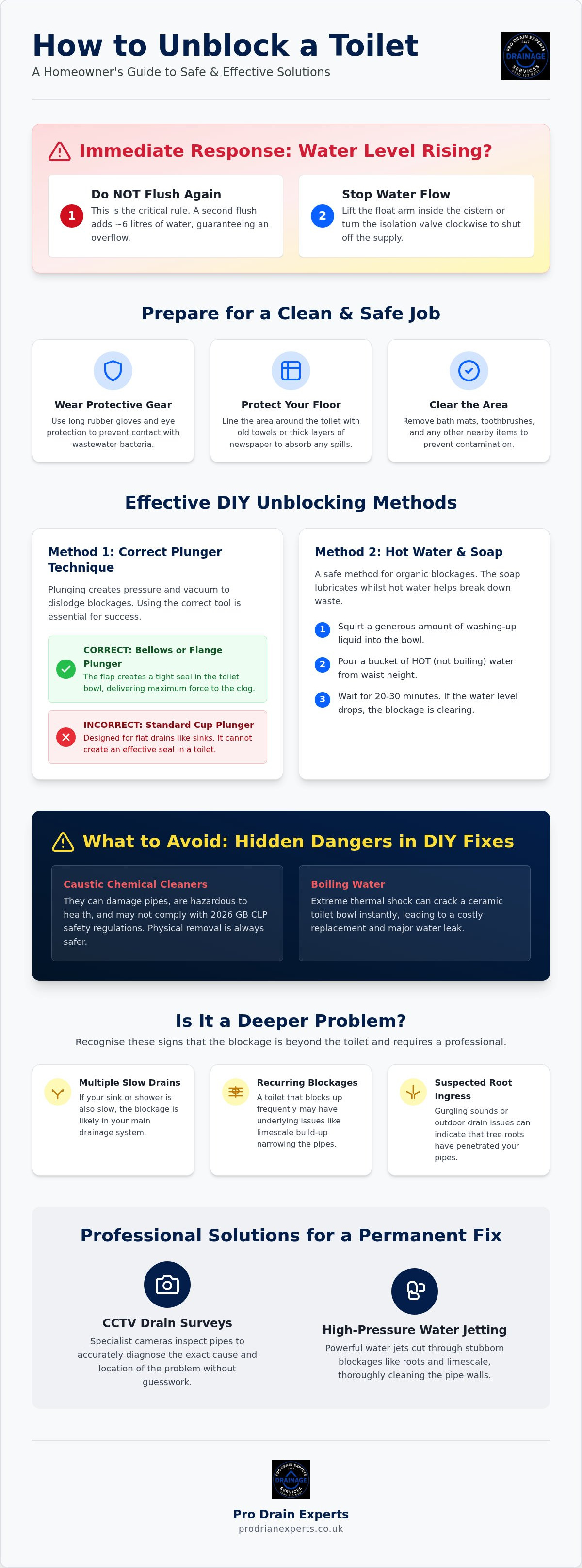
The sight of water rising toward the rim of your toilet is a universal homeowner's nightmare. Your first instinct might be to hit the flush handle again, hoping the extra pressure will force the obstruction through. Stop. This is the single most common mistake people make when learning how to unblock a toilet. A second flush adds roughly six litres of water to a bowl that is already at capacity, almost guaranteeing a flood of raw sewage onto your bathroom floor. You must act with professional calm to contain the situation before it escalates.
The "No-Flush" Rule and Tank Management
When a pipe is obstructed, the air trapped between the water and the blockage becomes compressed. Flushing again doesn't just add volume; it increases this air pressure, which can actually wedge the blockage tighter into the trap. If the water is still rising, you must stop the tank from refilling immediately. Remove the cistern lid and manually lift the float arm, which is the ball or cup that rises with the water level. This action tells the fill valve to shut off. For a more secure solution whilst you work, locate the isolation valve on the water pipe leading to the toilet and turn it clockwise using a flat-head screwdriver or your fingers. This ensures no more water enters the bowl, giving you the control needed to assess the problem.
Setting the Scene for a Clean Unblocking
Safety and hygiene are paramount when dealing with wastewater. Before you begin any physical attempts to clear the pipe, you must protect yourself and your home from contamination. Wear long-sleeved rubber gloves that reach your elbows and put on eye protection. Splashes happen unexpectedly during plunging, and wastewater carries harmful bacteria that you do not want in your eyes or on your skin.
Line the floor around the base of the toilet with thick layers of newspaper or old towels. Newspaper is often the better choice because you can simply roll it up and bin it once the job is finished. Clear away any bath mats, toothbrushes, or towels that are near the splash zone. By organising a clean work area now, you prevent the spread of bacteria through the rest of your house. Once the area is secure, take a moment to assess the situation. If other drains in your home are also running slow, the issue likely lies deeper in your Sussex drainage system rather than being a simple local clog. Knowing how to unblock a toilet effectively starts with knowing when the problem is bigger than the bowl itself.
Effective DIY Methods to Unblock a Toilet Bowl
Most household clogs respond well to physical pressure or simple lubrication. If you've secured the area as described in the previous section, you're ready to attempt a manual clear. Learning how to unblock a toilet effectively starts with choosing the right equipment. Many homeowners reach for a standard cup plunger, but these are designed for flat sink drains. For a toilet, you need a flange or bellows plunger. These tools feature a protruding rubber flap or a concertina shape that fits snugly into the toilet's exit hole, creating the airtight seal necessary to move the obstruction.
Mastering the Plunger Technique
Plunging isn't about brute force; it's about the physics of vacuum and pressure. First, ensure there's enough water in the bowl to completely submerge the plunger head. If the bowl is empty, add water manually. Without water, you're just pushing air, which compresses and fails to move the clog. Insert the plunger at an angle to avoid trapping a large air bubble inside the bell. Once the flange is seated firmly in the drain, push down slowly to expel the remaining air, then pull up sharply. This "push-pull" rhythm creates a vacuum that tugs the blockage back and forth, eventually breaking it apart or dislodging it so it can pass through the trap.
The Hot Water and Dish Soap Method
If the blockage consists of organic matter, lubrication is often more effective than pressure. Squirt a generous amount of washing-up liquid into the bowl and let it sink to the bottom. The soap acts as a lubricant, helping the clog slide through the ceramic curves. Follow this with a bucket of hot water poured from waist height. Crucially, the water should be hot but never boiling. Boiling water can cause the ceramic bowl to crack instantly, leading to an expensive replacement. Let the mixture sit for 20 minutes. If the water level starts to drop, the soap is doing its job. For more stubborn obstructions that refuse to budge with soap alone, you might need professional emergency unblocking to clear the line completely.
Eco-Friendly Clearing with Baking Soda and Vinegar
For minor build-ups, a natural chemical reaction can provide the necessary fizz to clear the path. Pour one cup of bicarbonate of soda into the bowl, followed by two cups of white vinegar. The resulting effervescence creates carbon dioxide gas, which can help loosen small organic clogs. This method is most effective when left to work overnight. Don't expect this to work on non-organic items like wet wipes or plastic toys; these materials don't react to vinegar and will require mechanical removal. If you've tried these steps without success, it's time to consider more advanced tools.
Advanced DIY Tools and the Dangers of Chemicals
If the plunger failed to produce results, you might feel tempted to reach for more aggressive measures. However, this is the stage where many homeowners accidentally cause permanent damage to their plumbing. Understanding how to unblock a toilet safely requires a respect for the structural integrity of your pipes, especially in older Sussex properties. Whilst high-street shops often promote "quick-fix" solutions, some tools and liquids can lead to expensive repair bills if used incorrectly.
Using a Toilet Auger Safely
A toilet auger, or closet auger, is a professional-grade tool designed specifically for the tight U-bend of a toilet. It's different from a standard drain snake, which is thinner and can easily scratch or crack the porcelain bowl. A proper auger features a protective rubber sleeve at the bend to prevent metal-on-ceramic contact. To use it, pull the handle all the way up, insert the head into the drain, and slowly crank the handle whilst pushing the cable deeper. If you feel solid resistance, you've likely reached the obstruction. If the cable feels springy or bounces back, you're simply hitting a pipe bend. Gently retract the cable once you've hooked the debris to pull it out, rather than pushing it further into the main line.
The Hidden Cost of Chemical Unblockers
It's easy to pick up a bottle of chemical unblocker for around £11.50, but these liquids carry significant risks. Most caustic cleaners work via an exothermic reaction, which generates intense heat to melt fats and proteins. In many Sussex homes with older lead or clay pipes, this heat can warp the pipework or melt the plastic seals in modern systems. Additionally, as of August 2026, all unblocking chemicals must comply with the updated GB CLP hazard standards. These regulations highlight the risk of toxic fumes and chemical burns. Mixing different brands is particularly dangerous, as it can create lethal chlorine gas in your bathroom.
Chemicals also struggle with the primary enemy of UK drainage: "flushable" wipes. These products don't break down like toilet paper; instead, they absorb the chemicals and form a hardened, rubbery plug. If you've spent more than 30 minutes with an auger or have already tried a chemical pour without success, you've reached the limits of DIY. Continuing to poke at a stubborn blockage often compacts it further, making it much harder for a professional to clear later. Recognising when to stop is the best way to protect your home from a total drainage failure.
Identifying the Root Cause: Why Your Toilet Keeps Blocking
If you find yourself searching for how to unblock a toilet every few weeks, you aren't dealing with a simple clog. You're likely facing a systemic issue within your property's drainage network. Recurring blockages are rarely a coincidence; they are usually a symptom of an underlying problem that a plunger cannot reach. In Sussex and Kent, local environmental factors often play a significant role in how well your pipes function over the long term.
Limescale and Hard Water Challenges
Sussex and Kent are famous for their chalky soil and exceptionally hard water. This geological reality means calcium carbonate deposits, commonly known as limescale, build up inside your pipes over time. Unlike the visible scale on your kettle, this build-up creates a rough, sandpaper-like interior surface within your drainage system. This texture catches toilet paper and organic matter, creating a "snag" that eventually leads to a full blockage. Over years, this narrowing of the pipe diameter significantly reduces flow capacity. If your toilet is constantly sluggish, you likely need professional descaling to restore the pipe's original bore and prevent future emergencies.
Beyond limescale, the "fatberg" phenomenon is a common culprit in domestic settings. Even if you only flush toilet paper, kitchen grease from your sink often migrates into the main soil pipe. When hot fats cool, they solidify and trap other debris, forming a hardened mass that narrows the outlet. This is often why a toilet feels blocked even when nothing unusual has been flushed.
External Drainage Issues and Manholes
In areas like Ringmer and Lewes, older properties often feature clay pipes that are vulnerable to tree root ingress. Tiny, hair-like roots find their way into pipe joints seeking moisture. Once inside, they grow into a dense, fibrous mat that acts as a filter, catching everything that passes through. You can check for this by locating your external manhole. If you lift the cover and the chamber is full of water, the blockage is downstream in the main sewer line. If the chamber is empty but the toilet is backed up, the issue is within your internal pipework.
Structural issues, such as collapsed pipes or sagging drains (bellies), can also cause persistent trouble. These often occur in older UK homes where the ground has shifted or the pipe material has reached the end of its lifespan. For persistent issues that DIY methods can't solve, you should book a CCTV drain survey to identify the exact cause before it leads to a total system failure.
Professional Solutions: When to Call Pro Drain Experts
There comes a point where manual plunging and basic DIY tools reach their limit. If you have followed every step on how to unblock a toilet and the water still refuses to recede, you are likely facing a deep-seated obstruction or a structural failure. Continuing to struggle with a stubborn clog can lead to pipe fatigue or accidental damage to your bathroom fixtures. Professional drainage engineers don't just guess at the problem; they use industrial-grade technology to restore your system to full health.
The Power of High-Pressure Water Jetting
Whilst traditional drain rodding can sometimes dislodge a blockage, it often simply pushes the debris further down the line or, worse, punctures older clay pipes common in Sussex. High-pressure water jetting is a far more effective and non-invasive alternative. This technique uses a flexible hose that navigates the twists of your plumbing to deliver a concentrated stream of water at incredible force. It doesn't just clear the immediate obstruction; it scours the internal walls of the pipe, removing the limescale and fat build-up we discussed in the previous section. This thorough cleaning process leaves your drains in a "near-new" condition, significantly reducing the chance of a repeat emergency.
CCTV Surveys: The Diagnostic Gold Standard
One of the biggest advantages of calling in a specialist is the ability to see exactly what is happening underground. For recurring issues that defy standard methods, a CCTV drain survey is essential. We feed a high-definition, waterproof camera into your drainage network to identify cracks, root ingress, or collapsed sections without the need for disruptive digging. This precision is invaluable for homeowners in Kent and East Sussex who need evidence for insurance claims or want a clear report before purchasing a new property. By seeing the problem clearly, we can provide a fixed-rate solution that targets the root cause rather than just the symptoms.
Local Reliability in Sussex and Kent
When sewage is threatening to overflow, waiting for a national franchise can feel like an eternity. Local expertise matters. A team based in Ringmer or Lewes understands the specific drainage layouts and geological challenges of the area, from chalk-heavy water to historic pipework. We prioritise an hour-response time for emergency toilet unblocking because we know that every minute counts in a flood situation. Choosing a local authority ensures you receive a transparent, service-first experience from professionals who take pride in their community. If your DIY efforts have stalled, it is time to let the experts take over. Contact Pro Drain Experts for 24/7 emergency support to get your home back to normal today.
Restoring Your Home's Drainage Health
Mastering how to unblock a toilet starts with immediate containment and ends with a permanent solution. By following the "no-flush" rule and using the correct plunging techniques, you can resolve many minor clogs without causing a mess. It's vital to remember that whilst DIY methods are effective for surface-level issues, recurring blockages often signal deeper structural problems. Whether it's the heavy limescale build-up common across Sussex or invasive tree roots in older Kent properties, some obstructions require professional intervention.
Don't let a stubborn blockage cause unnecessary stress or damage to your plumbing. Our local experts based in Ringmer provide 24/7 emergency response and use specialist CCTV drain survey technology to find the exact cause of your trouble. We're here to offer the reliable, expert-led support you need to keep your home running smoothly. Book an Emergency Drain Unblocking with Pro Drain Experts today for a fast, fixed-rate resolution. You've taken the right first steps to protect your home; let us handle the heavy lifting to ensure your drains stay clear for the long term.
Frequently Asked Questions
Is it okay to leave a blocked toilet overnight?
We generally advise against leaving a blockage overnight. Sewage sitting in the bowl can release harmful bacteria and unpleasant odours into your home. Furthermore, if the water level is high, there is a constant risk of a slow leak or an overflow if the fill valve fails. It is always safer to address the issue immediately to prevent potential structural damage or hygiene risks in your bathroom.
Will a toilet eventually unblock itself?
It is highly unlikely that a toilet will unblock itself. Whilst water might slowly seep past a partial organic clog over several hours, the actual obstruction, such as compacted paper or wipes, remains in the pipe. Leaving it often allows the material to settle and harden, which can make the eventual removal much more difficult. Professional intervention is usually required for a permanent and hygienic fix.
Can I use a coat hanger to unblock a toilet?
You should never use a wire coat hanger to clear a drain. The rigid metal can easily scratch the porcelain finish or, worse, puncture the internal wax seal, leading to leaks beneath the floorboards. Hangers are also too short to reach clogs beyond the immediate U-bend. If a plunger fails, the only safe mechanical tool is a dedicated toilet auger with a protective rubber sleeve.
How much does a professional drain unblocking cost in Sussex?
Costs for professional unblocking in the UK vary depending on the severity of the obstruction and the equipment required. Most reputable local engineers operate with a call-out fee that covers the initial assessment and basic clearing. For more complex issues involving high-pressure water jetting or CCTV surveys, you should expect a transparent, fixed-rate quote. This ensures you understand the full cost before any advanced work begins.
What is the best plunger for a UK toilet?
A bellows plunger or a flange plunger is far superior to the traditional flat cup plunger. These models feature a protruding rubber flap or concertina shape designed to fit the contoured exit hole of a toilet bowl. This creates the airtight seal necessary to generate the pressure required when learning how to unblock a toilet effectively. They are much more efficient at moving obstructions than basic sink plungers.
Why is my toilet bubbling when I run the shower?
Bubbling or gurgling indicates a significant blockage in the main soil pipe or the vent stack. When water from your shower travels down the drain, it pushes air ahead of it. If that air cannot escape through the main sewer line, it is forced back through the toilet's water trap, causing bubbles. This is a clear sign that your drainage system requires a professional diagnostic check.
Are "flushable" wipes really safe for my drains?
No, "flushable" wipes are one of the primary causes of UK drainage failures. Despite their labelling, these wipes do not disintegrate like toilet paper. Instead, they snag on rough pipe surfaces or limescale build-up, eventually forming resilient masses known as fatbergs. To protect your home's plumbing, you should only ever flush the "three Ps": pee, poo, and paper. Everything else should go in the bin.
How do I know if my external drain is blocked?
The most reliable way to check is by locating your external manhole or inspection chamber. If you lift the lid and see standing water or raw sewage, the blockage is in the external pipework. Other signs include multiple slow-running fixtures throughout the house and foul smells coming from outside gullies. If you are unsure how to unblock a toilet that is backing up due to external issues, seek professional help.


